Runtime Environment
This content is adapted from the "Rise AI Compute Management Platform Technical White Paper" and describes the software dependencies, production resource configuration recommendations, hardware and OS compatibility, and AI framework support required to deploy the Rise AI Compute Platform.
Software Dependencies
| Category | Software | Version |
|---|---|---|
| Operating System | Ubuntu | 20.04 |
| Container | Docker / containerd | 20.10+ |
| Orchestration | Kubernetes | 1.23+ |
| Storage | NFS shared storage | Platform database and model data storage |
Production Resource Configuration Recommendations
- Management nodes (Master): At least 3 CPU servers in a high-availability deployment; CPU 2.5 GHz / 10+ cores, memory 32 GB+, disk 200 GB+, 10G network uplink.
- GPU worker nodes (Worker): 1 to n nodes; CPU 2.5 GHz / 10+ cores, memory 64 GB+, disk 200 GB+; NVIDIA GPU ≥ 2 cards or Ascend/Enflame/other compute cards. For multi-node multi-card training/inference, we recommend at least 200G parameter exchange interconnect.
Deployment Topology
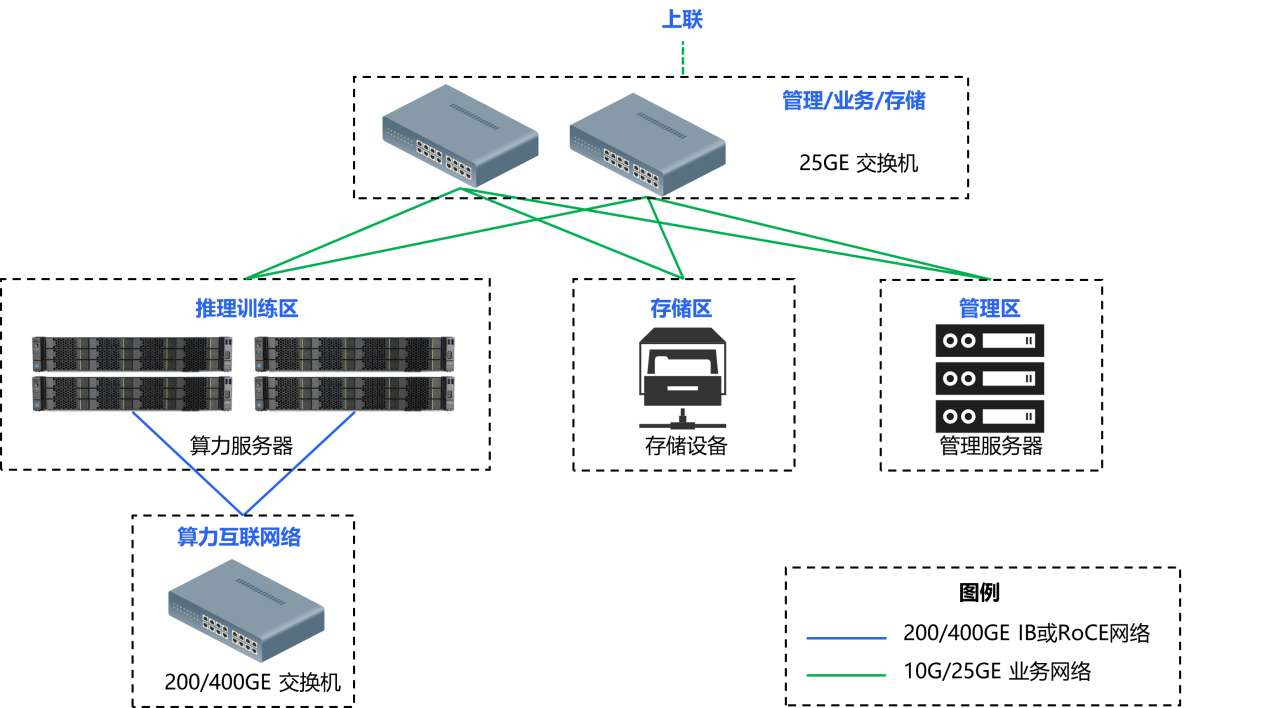
A typical production environment is divided into inference/training, storage, and management zones. Compute servers are interconnected via 200/400GE IB or RoCE networks, with management, business, and storage traffic on 10G/25GE switches:
Hardware and Operating System
- Processors: x86 architecture (Intel, Hygon, etc.) and ARM architecture (Kunpeng, Ascend, etc.).
- Operating Systems: CentOS 7/8, RHEL 7/8, Ubuntu 20/22, as well as domestic operating systems such as Euler 22.03-LTS, UOS, and Kylin V10-SP1.
AI Framework Support
- Compute libraries: CUDA 9.x+, cuDNN 7.4.2+, CANN (Ascend), Neuware (Cambricon), DTK (Hygon), ROCm, etc.
- Training frameworks: PyTorch 1.0+, TensorFlow 1.8+, PaddlePaddle 1.5+, MindSpore 2.0+, MXNet 1.4+, ONNX 1.0+.